
- Buy Crypto
- Markets
- Futures
- Spot
- Copy Trade
 Earn
Earn- More
Alpha Hunter: Top 5 Up-and-Coming Projects and Token Insights

Original Title: Top 5 Hot Projects & Their Upcoming Token Launches
Original Author: IGNAS
Original Translation: Deep Tide TechFlow

The pace of new token issuance has slowed down, but I believe it will soon pick up as the market is slowly recovering.
Many projects can't delay any longer.
These projects will be taking the plunge, paving the way for others. In this article, I would like to focus on some of the protocols that frequently appear in my X Stream. However, it seems not everyone is familiar with their roles.
A year ago, I wrote a similar blog post about 7 major projects and planned to publish these articles more frequently, so feel free to subscribe at any time.
So if you are one of those followers on X eagerly awaiting the token launches and airdrops of hyped projects (but don't really understand their role), then this article is for you.
Initia - The Multichain Eden
Initia is the debut sale conducted by Cobie's Echonomist Group on its Echo fundraising platform.
Cobie's team has only done three project fundraisings, which might make the situation bullish. The mainnet and airdrop should be launching soon (although it seems to be delayed to April).
If there is one word you should associate with Initia, it's "Interwoven."

Initia is an L1 that integrates L2 to create a modular network for application chains.
It sounds like Ethereum, but Initia addresses the issues ETH maxis don't like about Ethereum.
Unlike Ethereum L2s running in isolation, Initia merges Layer 1 with Layer 2, creating an interwoven ecosystem. They refer to these L2s as Minitias. It's similar to Avalanche subnets (recently rebranded as L1) as well.
Unlike Ethereum but similar to Avalanche, OPinit Stack supports EVM, MoveVM, and WasmVM. Therefore, developers can use any language they see fit.
This may make ETH whales drool. Initia's Enshrined Liquidity allows staking either the INIT token alone or approved INIT-X LP tokens (paired with INIT) to earn rewards through Delegated Proof of Stake (DPoS) mechanism.
Fixed liquidity is a prime example of Ponzi tokenomics, requiring 50% or more of INIT to be paired as the pairing token for all ecosystem tokens. These LP tokens must be whitelisted by governance.
Similar to Berachain, Initia also has a native dex: the InitiaDEX on L1 built with the Move programming language. It serves as the liquidity hub of the Omnitia ecosystem, and to my understanding, most liquidity will flow through InitiaDEX (and through mandatory INIA pools) even between L2s.
Initia offers more features, such as native bridging (aptly named Minitswap) and a rent-seeking program (aggregating rewards for creating applications and new use cases for INIT), but these four features stand out to me.
Initia truly encapsulates Ethereum natives' demands on Ethereum into a product, making it an interwoven ecosystem.
Tokens and Fundraising
The full Tokenomics have not been fully rolled out. Initia has only shared four details about it:
· 50% of the supply allocated to VIP and Enshrined Liquidity
· Insider unlockable staking rewards
· Community rounds discount of approximately 30%.
· 15% allocated to investors.
We can expect airdrops, as Initia co-founder Zon puts it, "Vesting unlocks are a gift. It can prevent you from giving up too early and forces you to believe."
In September 2024, Zon also shared with Block the details of Initia's previous Series A funding round, raising $14 million from companies such as Theory Ventures, Delphi Ventures, and Hack VC, with an FDV of $350 million.
The testnet has an incentive mechanism, so feel free to visit the official testnet website, obtain testnet tokens, and participate in its ecosystem. All information can be found on the testnet page here.
As usual, I don't have high expectations for testnet activities.
Overall, the ecosystem is well-built. The key question remains: Will builders and users choose to engage with it?
Fogo - The Fastest L1 Blockchain
Fogo is another project that conducted a token sale within Cobie's own Echo Group, raising $8 million at a valuation of $100 million.
Fogo utilizes the highly optimized Solana validator client Firedancer created by Jump Crypto as the network's sole execution client.
It hasn't even launched on Solana yet. Solana will soon benefit from the Firedancer client, but not all validators can switch to it immediately. This means the network speed is limited by the slowest node.
As Fogo co-founder Doug Colkitt puts it: "It's like having a Ferrari but driving it in New York City traffic jams."
Under optimal conditions, their theoretical speed reaches 1 million transactions per second, with a block time of 20 milliseconds, but Fogo's live developer network reaches approximately 54,000 TPS. In comparison, Solana currently has a theoretical limit of 65k TPS but is currently at 4.3k.
The MegaETH testnet drives 20k TPS with a 10-millisecond block time.
In contrast, TradFi systems can process over 100,000 operations per second with sub-millisecond latency.
The Fogo team believes that a decentralized network must be capable of supporting institutional-grade use cases such as high-frequency trading and instant payments.
It runs on the Solana Virtual Machine (SVM), which means developers can easily migrate Solana applications, tools, and infrastructure to Fogo without any modifications. It is anticipated that there will be a series of forks with new shiny tokens (Jupiter, Kamino, Pumpfun, etc.).
Clearly, not everyone in the Solana ecosystem is thrilled about this.
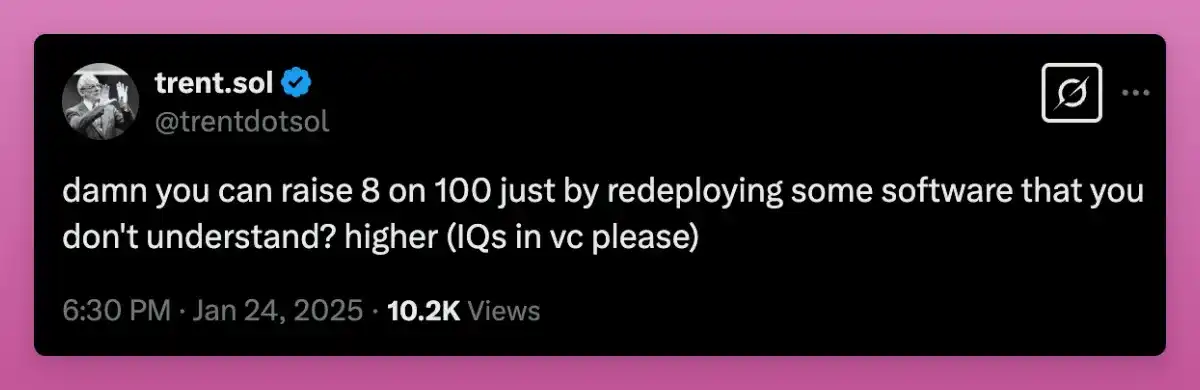
Notably, Fogo's contributors include members of Douro Labs, the team behind the Pyth Oracle Network, which itself has close ties to Jump Crypto.
Other significant features:
Multi-Local Consensus ("Follow the Sun"): Fogo groups validators into geographically semi-independent working "regions." Control rotates regularly to the next region, preventing any single location from dominating. This means faster consensus can be reached during normal operation, as messages don't always have to traverse the entire globe. More information can be found here.
At launch, it will initially have a curated set of validators (20-50).
Fee Abstraction: Transaction fees can be paid in any token.
Tokens and Funding
Fogo raised approximately $5.5 million in a seed round led by Distributed Global, with participation from CMS Holdings. This is the largest amount in Echo Group's $8 million funding raise.
The Devnet is expected to launch by the end of 2024, with the testnet coming soon and the mainnet scheduled for a mid-2025 release. Currently, there is limited information regarding tokens or airdrops.
Succinct – Software for a Proofed World
"Cryptocurrency has failed to fulfill its mission.
We were promised a transparent, verifiable, trustless global coordination system. Yet, what we got was bridge hacks, multi-sig L2 without fraud proofs, and a 21-validator committee controlling billions of dollars."
This is the main problem Succinct is solving.
“ZK Proof is one of the most crucial technologies for blockchain scalability, interoperability, and privacy, but it is too complex for most developers today.”
It's hard to get excited about ZK Proof right now, but Succinct has caught my attention with its excellent marketing efforts and a testnet/website dashboard as a MacOS interface.
You can play games and earn points.
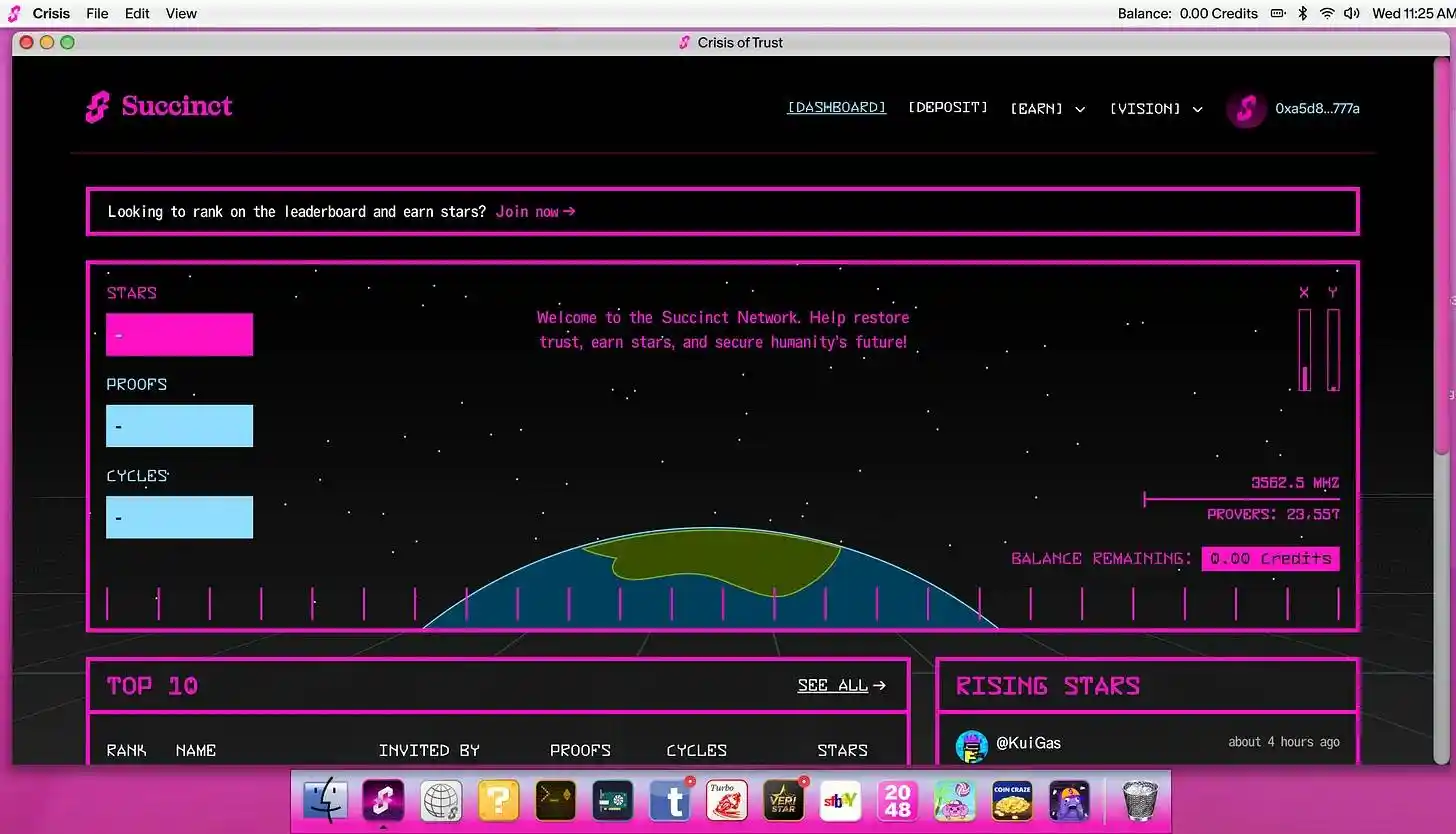
Anyway. The problem we are facing now is:
· Every project must build its own proof system (e.g., zkSync and Scroll use zero-knowledge for scalability, but the infrastructure is fragmented.)
· Many rely on centralized providers to generate proofs.
· This is not only costly but also slows down innovation.
Thus, concise ZKP (a technology that cryptographically proves authenticity without revealing data) is challenging to implement due to fragmented infrastructure and high costs.
Succinct offers a shared proof generation market rather than each project reinventing the wheel. Developers can focus on building applications (aggregators, bridges, oracles) while outsourcing proof creation to the network.
Key Partners: Polygon, Celestia, Avail, Gnosis.
But use cases are even more diverse, such as a private voting system or anonymous transactions. Or you can prove that you have money in your wallet without revealing how much.
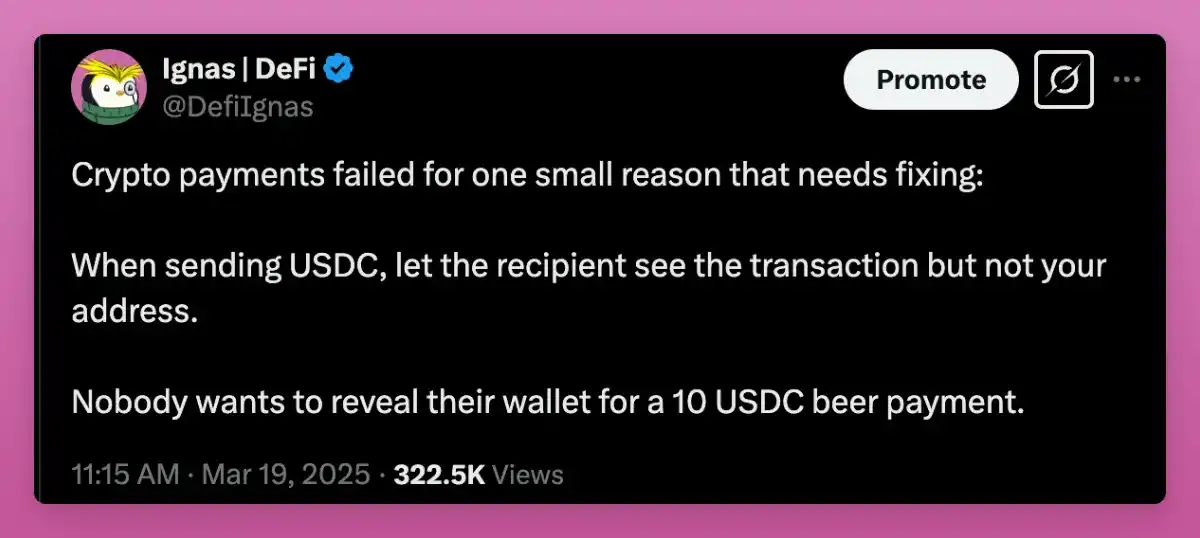
It’s a technical project, but it could become the glue of the most vulnerable crypto projects, decentralization, and protection.
Their testnet “Tier One: Trust Crisis” launched two months ago. You can earn stars by generating zero-knowledge proofs. You need a $10 USDC deposit to cover the proof generation cost. But to get an invite code, you need to farm it on platforms like X, Discord, etc.
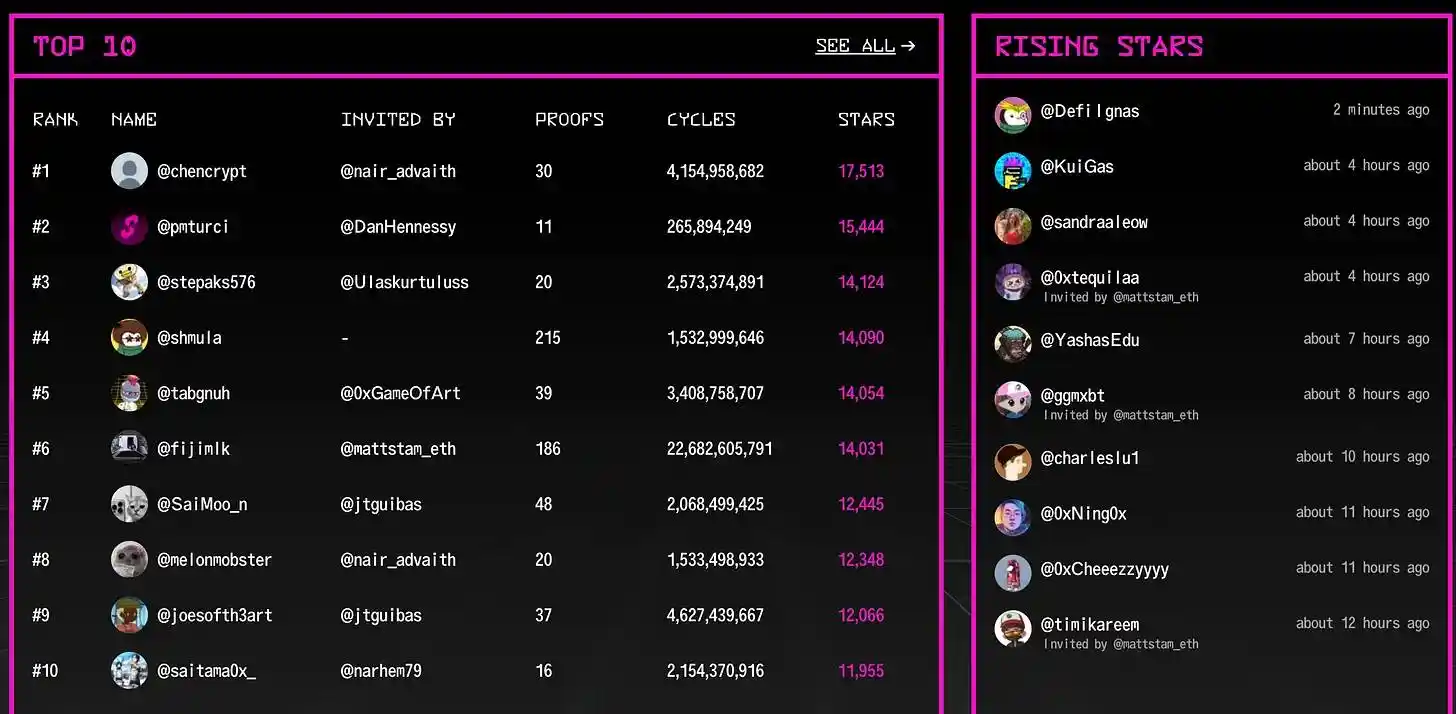
I believe this will be the standard for airdrops, but detailed information about the token is not yet public.
Succinct raised $55 million, led by Paradigm and joined by Robot Ventures, Bankless Ventures, Geometry, and several other companies.
Upon mainnet launch, the TGE is expected to happen quickly.
Resolv - Truly Effective Delta-Neutral Stablecoin
Many now believe that the next wave of altcoin growth will be driven by increased institutional adoption, particularly of stablecoins.
The issue is that the primary beneficiaries of stablecoin adoption seem to be institutions and stablecoin issuers, with retail investors possibly seeing only marginal benefits.
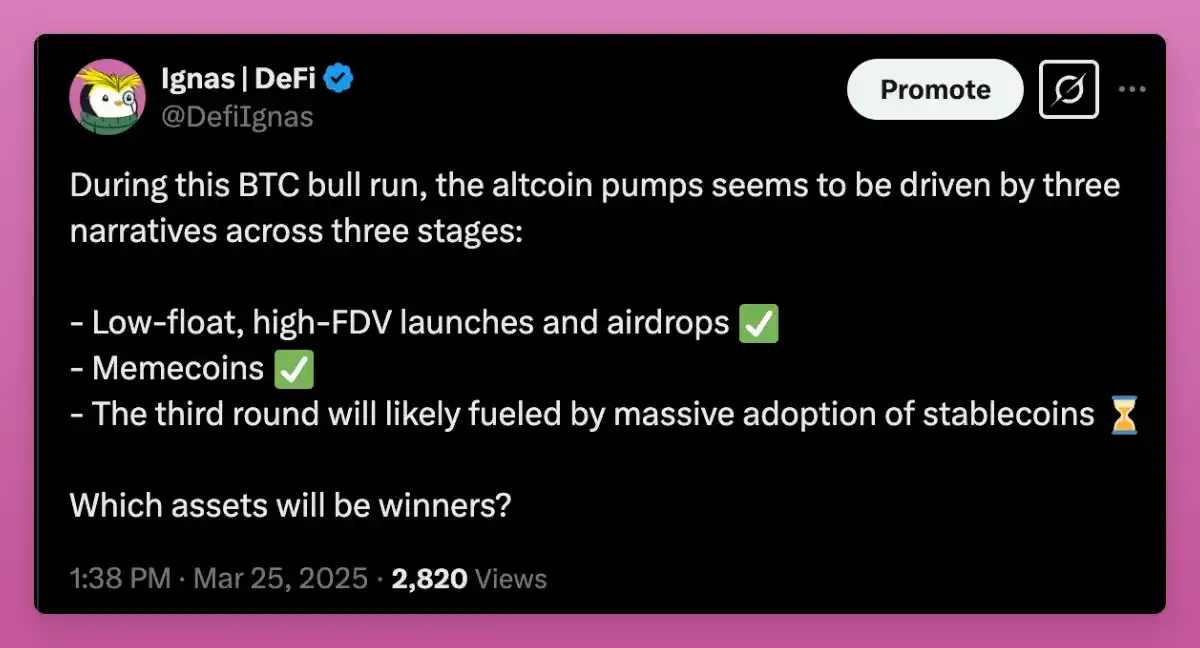
I wrote some thoughts on protocols that could benefit from stablecoin adoption, but I want to add one here—Resolv.
If you understand how Ethena works, you already have a good foundation for understanding Resolv.
The core idea of both is the same—using crypto collateral along with short-term perpetual hedging to create a stablecoin. However, Resolv's architecture and approach are different:
First is the dual token model vs. the single token model: Ethena has a single token model (USDe) where all risks and rewards flow to stablecoin holders and are managed by the protocol's reserve in the background.
Resolv uses a dual token model (USR + RLP), explicitly isolating risk into separate tokens.
· USR: Like USDe, USR hedges the ETH price through shorting futures, using a delta-neutral strategy to maintain its peg. You can stake USR to earn yields, converting it to stUSR, akin to a savings account.
· RLP: Acts as insurance for USR, absorbing losses to keep USR stable (e.g., when funding rates are negative). RLP holders take on risk for higher returns. RLP's value fluctuates with the protocol's performance, acting as a buffer: it grows with profits and shrinks with losses.
This setup allows risk-tolerant users to earn more yield while protecting stablecoin users from market risk. As of writing this article, the APR for USR is 4.3%, and for RLP, it is 6.7%.
Although not very high, the airdrop farming has helped Resolv achieve a TVL of $6.369 billion. Not bad.
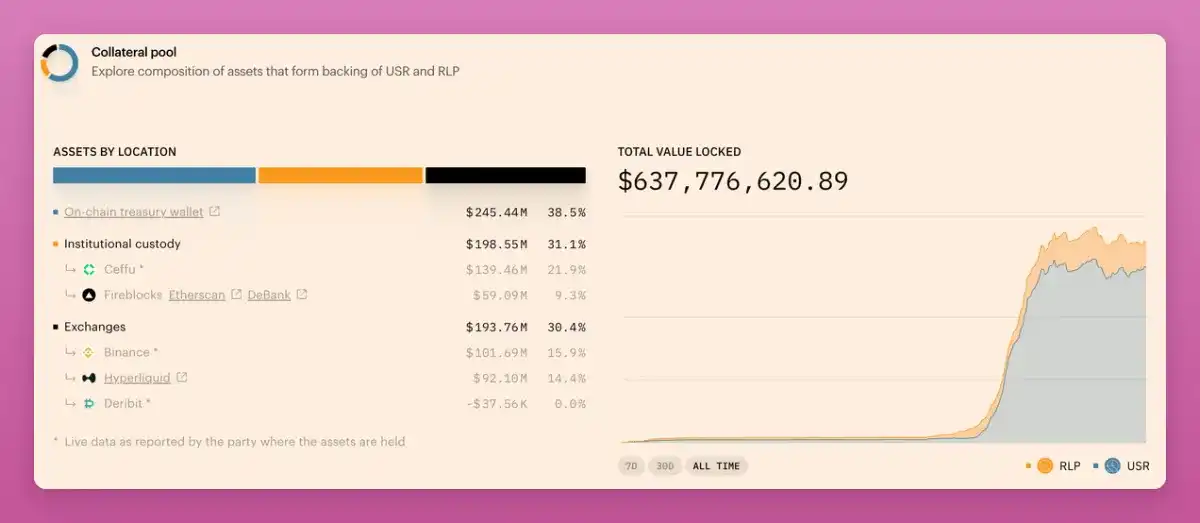
Secondly, Resolv's concept is to maintain 100% cryptocurrency backing. All collateral is in ETH (with BTC support recently announced), with no involvement of RWAs.
Initially, Ethena also supported only cryptocurrencies, but later introduced the secondary stablecoin USDtb, 90% backed by BlackRock's tokenized currency market fund (BUIDL).
For Resolv, USDtb serves as a kind of insurance token similar to USR, designed to stabilize USDe during bear markets by providing traditional asset yields when cryptocurrency yields decrease.
Therefore, you could say that Resolv is more "crypto-native" and spiritually decentralized, although Ethena's strategy can gain additional stability by introducing centralized assets.
Tokens and Fundraising
Resolv has not yet officially disclosed fundraising details, but supporters include Delphi Labs, Daedalus, and No Limit Holdings. They are preparing to launch a community fundraising through Legion soon.
Since September 2024, Resolv has been operating a rewards program. You can still join by depositing stablecoins and earning rewards.
After depositing, you can maximize rewards through the Pendle pool or other strategies.
The $RESOLV token is expected to launch in early 2025.
Snapchain—Possibly the Largest Consumer L1
My biggest concern is whether Fogo, Initia, and other upcoming chains will be adopted, and what killer apps they will launch. As Kyle put it:
"Generic blockchains will fade away. Each blockchain needs a specific use case, defined by the content built on top of it."
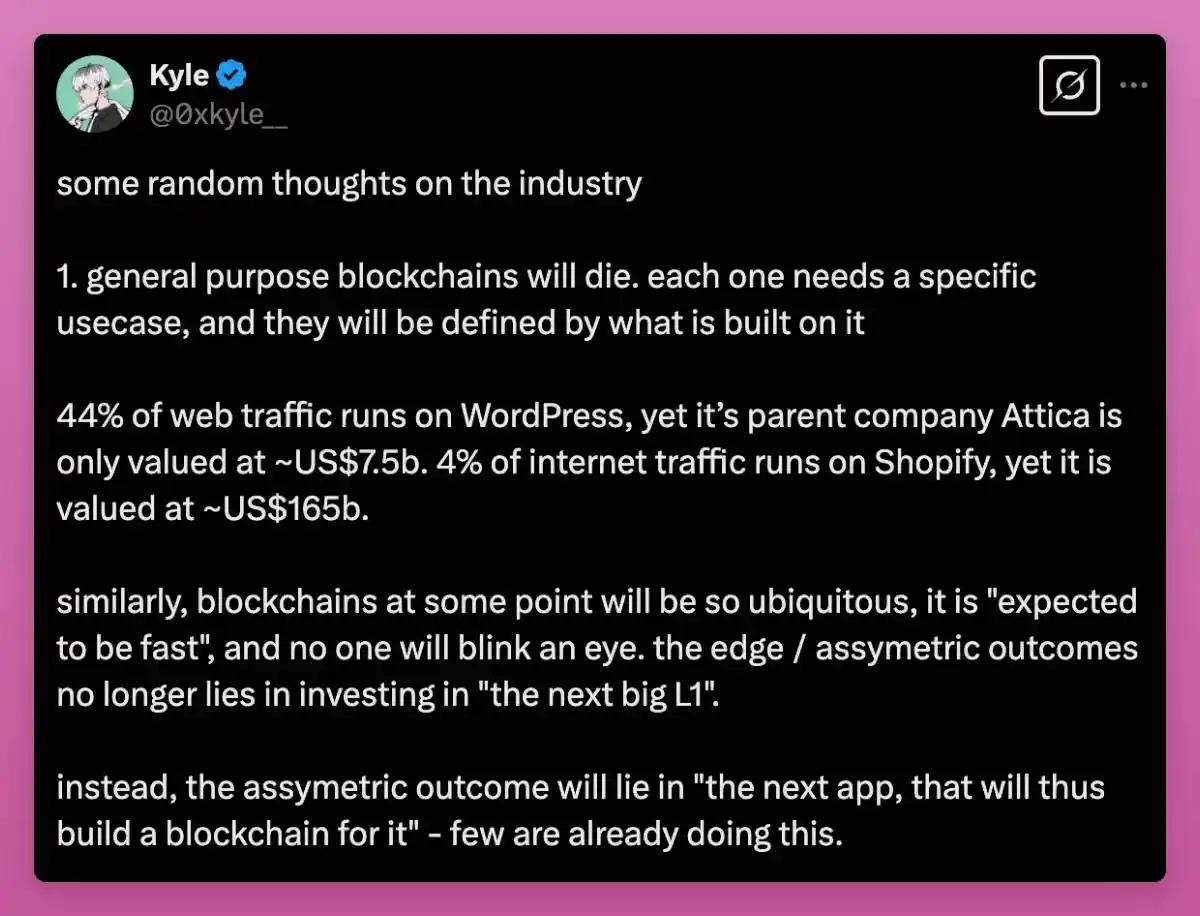
This is where the L1 Snapchain, built for the Farcaster social network, comes into play.
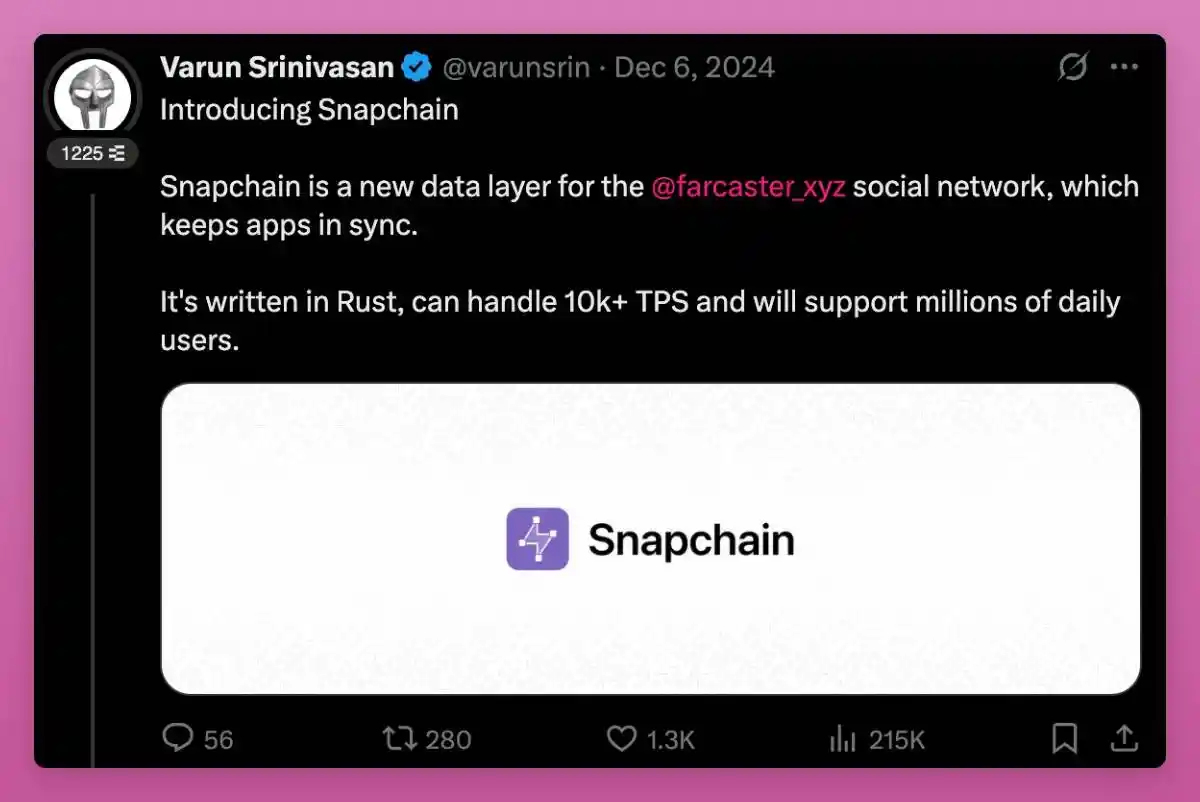
The reason Snapchain is necessary is that decentralized social networks struggle to stay synchronized and provide real-time updates as they scale. Lens will use zkSync technology, but Farcaster is developing its own tech.
For example, "Twitter has 200 million users per day, processes 10,000 messages per second, and the data for that state may grow at a rate of 1TB - 10TB per day."
Farcaster's current system operates at a small scale, but as the user and node count grows, it starts to fail. Snapchain will address this issue in a decentralized manner.
At launch, it should support 9k+ TPS, thus accommodating 2 million daily users (current DAU is around 50k).
I won't dwell too much on the technical details, but there are two exciting parts:
First, data deletion (pruning), haha. On the blockchain, most data is meant to be held permanently, but what if you post a meme and immediately regret it? It has to disappear! Permanently.
So, on Snapchain, once old data (posts, likes, follows) is no longer needed, it can be deleted.
This is crucial because users pay an annual fee of 2 or 3 dollars to get a storage limit of 500 tx/hour and around 10,000 tx.
Therefore, by deleting old transactions, you open up space for new ones (or you'd need to pay more fees).
The second cool part is sharding. Remember, Ethereum considered sharding before moving to layer 2 scaling.
Imagine putting all social media transactions (likes, posts, etc.) on-chain. That's millions of transactions daily. If every node has to store and process all of it, it becomes overwhelming. Every full node has to process every transaction, even those that don't affect them. This is fine for money and smart contracts, but for real-time social interactions, it doesn't scale well.
Snapchain addresses this by making each user completely independent (when you sign up on Farcaster, you get an ID, and if your ID is the lowest, it's a status symbol). Your posts don't affect my account.
Therefore, Snapchain will shard users into multiple partitions (by the way, this is inspired by the Near model). Each shard processes only its users. This means more users = more shards = higher throughput.
To keep everything in sync, there is one final layer: bundling the shards and publishing global blocks on the main chain.
Ethereum struggles to do this easily. Its transactions rely on shared state—smart contracts, tokens, balances. This makes account-level sharding difficult.
Snapchain is effective because social behaviors are simple. They only impact the sender.
There is more content you can read about here, but I'm bullish on Farcaster and Snapchain because it builds the use case first and then adds blockchain to it.
It's performing well for Hyperliquid, even with 50k DAU and 900k total users, Farcaster remains one of the top consumer apps.
Tokens & Funding
TLDR: The Genesis block is live, and the mainnet is expected to launch on April 15, 2025. So, it's coming soon.
I believe once Snapchain is live and Farcaster is ready to scale, Coinbase x Farcaster will start announcing integrations with the Coinbase Wallet.
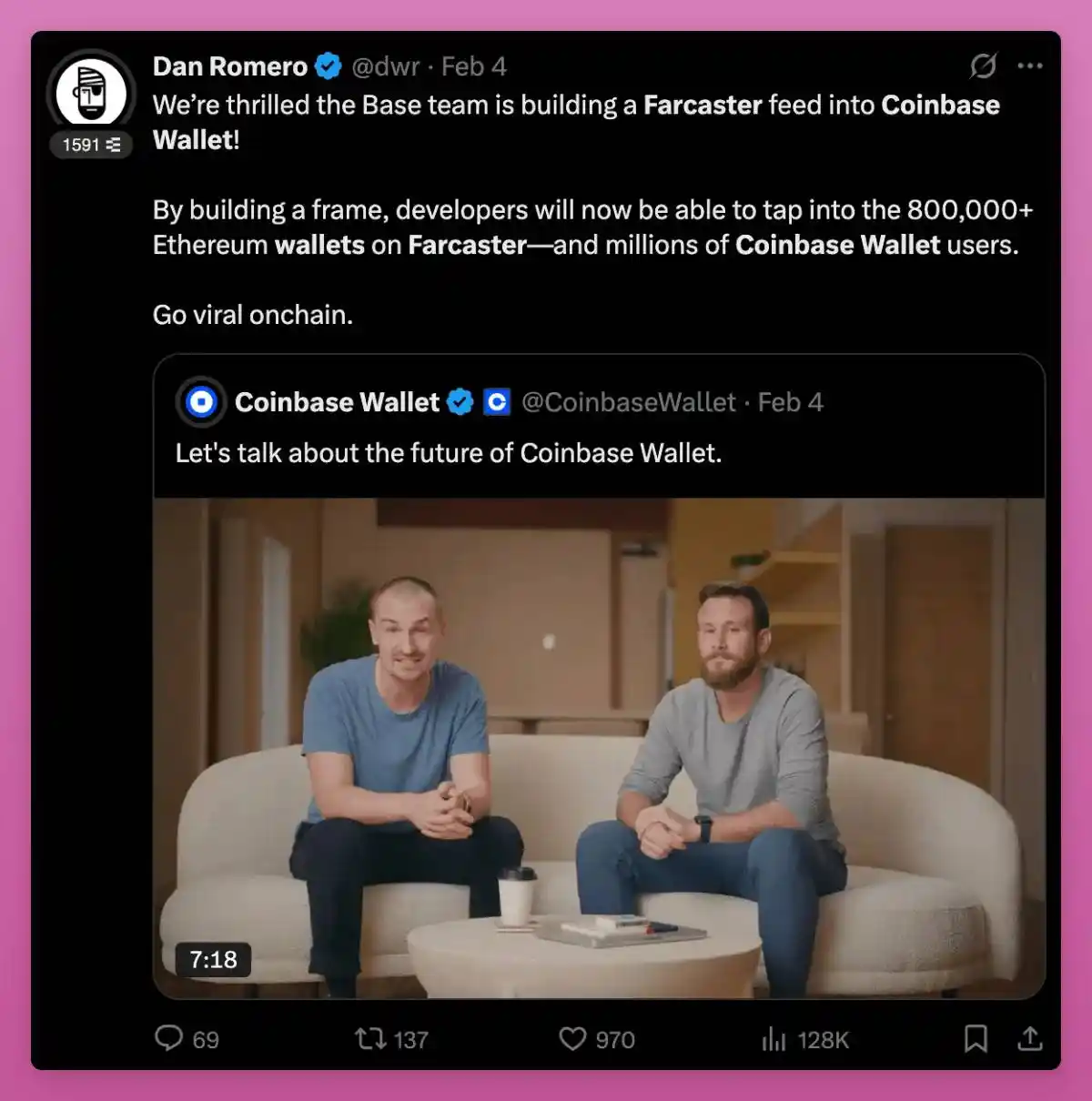
This is a huge deal. Social media info on Coinbase Wallet? I'm serious.
However, I'm not sure when the token will go live; the team has been silent about it, but some rumors and funding announcements may indicate it's on the horizon. Snapchain itself is a technical component, not a standalone fundraising entity. Development of Snapchain is funded by the company building the Farcaster protocol, Merkle Manufactory.
Most notably, in May 2024, they announced a $1.5 billion funding round led by Paradigm, with other major investors such as a16z crypto, Haun Ventures, USV, Variant, and Standard Crypto also participating.
Extra Bonus for You: Eclipse and Atlas
I originally planned to write about 7 major TGEs and protocols, but this article got too long. I always get carried away (often deleting 30% of the content before publishing!)
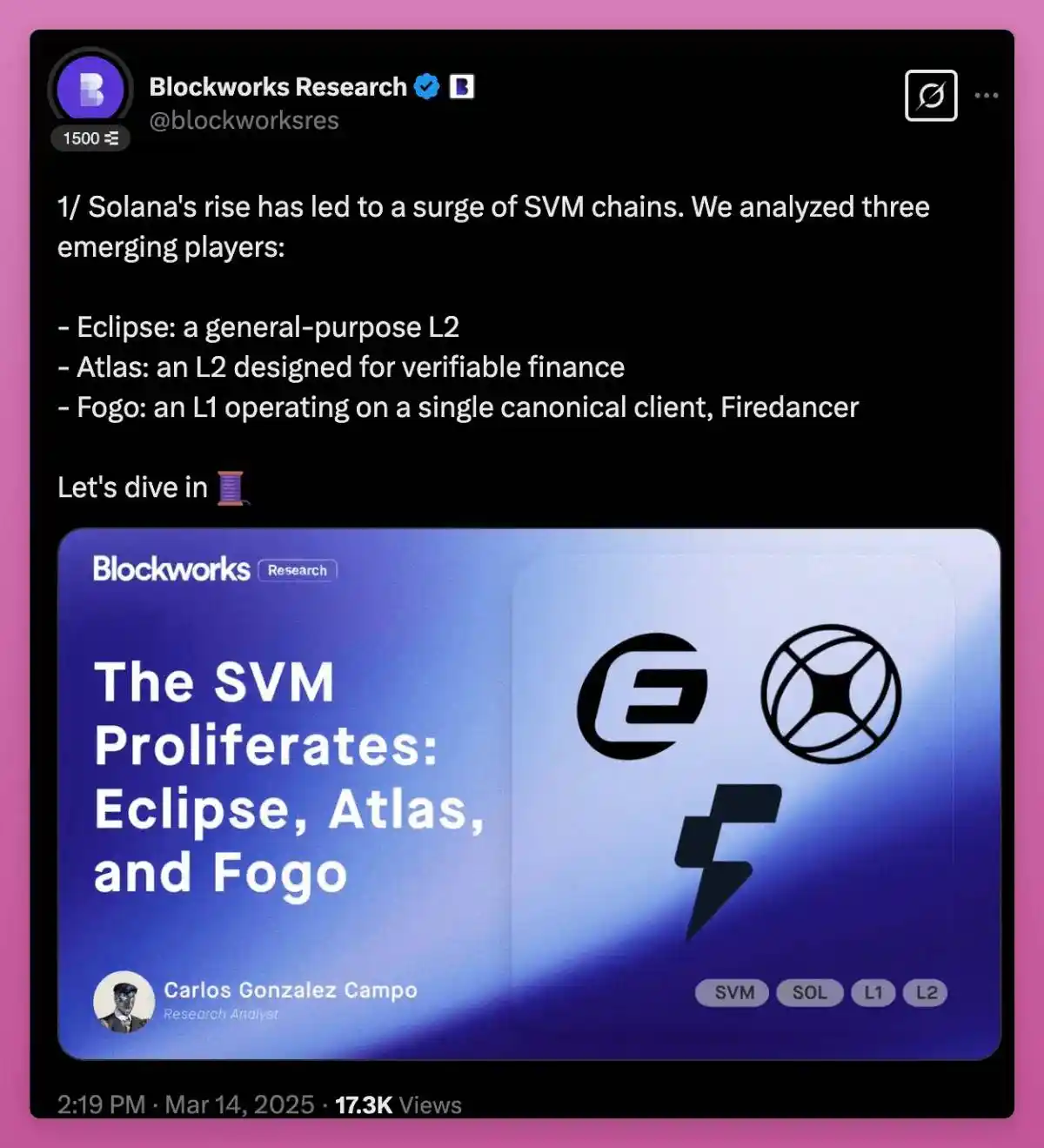
Eclipse and Atlas are two additional SVM (Solana VM) chains on Fogo.
Eclipse is an Ethereum L2, but it uses SVM instead of EVM and employs Celestia for DA. It has already launched, but the total locked value is only $57 million. As Kyle (above tweet) pointed out, this shows how challenging it is to differentiate from other general chains.
A standalone SVM is not enough to stand out from other L2s.
The token appears to have been confirmed as code ES:
· E-Ethereum
· S-Solana
Atlas is another Ethereum-based L2 SVM, but built specifically for on-chain order books, margin systems, and high-frequency trading. Hence it needs speed! The testnet is already live.
As I know you're itching to get back to X for some surfing, here's more information on Eclipse and Atlas provided by Blockworks.
You may also like

Russia’s Largest Bitcoin Miner BitRiver Faces Bankruptcy Crisis – What Went Wrong?
Key Takeaways BitRiver, the largest Bitcoin mining operator in Russia, faces a bankruptcy crisis due to unresolved debts…

Polymarket Predicts Over 70% Chance Bitcoin Will Drop Below $65K
Key Takeaways Polymarket bettors forecast a 71% chance for Bitcoin to fall below $65,000 by 2026. Strong bearish…

BitMine Reports 4.285M ETH Holdings, Expands Staked Position With Massive Reward Outlook
Key Takeaways BitMine Immersion Technologies holds 4,285,125 ETH, which is approximately 3.55% of Ethereum’s total supply. The company…

US Liquidity Crisis Sparked $250B Crash, Not a ‘Broken’ Crypto Market: Analyst
Key Takeaways: A massive $250 billion crash shook the cryptocurrency markets, attributed largely to liquidity issues in the…

Vitalik Advocates for Anonymous Voting in Ethereum’s Governance — A Solution to Attacks?
Key Takeaways Vitalik Buterin proposes a two-layer governance framework utilizing anonymous voting to address collusion and capture attacks,…

South Korea Utilizes AI to Pursue Unfair Crypto Trading: Offenders Face Severe Penalties
Key Takeaways South Korea is intensifying its use of AI to crack down on unfair cryptocurrency trading practices.…

Average Bitcoin ETF Investor Turns Underwater After Major Outflows
Key Takeaways: U.S. spot Bitcoin ETFs hold approximately $113 billion in assets, equivalent to around 1.28 million BTC.…

Japan’s Biggest Wealth Manager Adjusts Crypto Strategy After Q3 Setbacks
Key Takeaways Nomura Holdings, Japan’s leading wealth management firm, scales back its crypto involvement following significant third-quarter losses.…
CFTC Regulatory Shift Could Unlock New Opportunities for Coinbase Prediction Markets
Key Takeaways: The U.S. Commodity Futures Trading Commission (CFTC) is focusing on clearer regulations for crypto-linked prediction markets,…
Hong Kong Set to Approve First Stablecoin Licenses in March — Who’s In?
Key Takeaways Hong Kong’s financial regulator, the Hong Kong Monetary Authority (HKMA), is on the verge of approving…

BitRiver Founder and CEO Igor Runets Detained Over Tax Evasion Charges
Key Takeaways: Russian authorities have detained Igor Runets, CEO of BitRiver, on allegations of tax evasion. Runets is…

Crypto Investment Products Struggle with $1.7B Outflows Amid Market Turmoil
Key Takeaways: The recent $1.7 billion outflow in the crypto investment sector represents a second consecutive week of…

Why Is Crypto Down Today? – February 2, 2026
Key Takeaways: The crypto market has seen a downturn today, with a significant decrease of 2.9% in the…

Nevada Court Temporarily Bars Polymarket From Offering Contracts in the State
Key Takeaways A Nevada state court has temporarily restrained Polymarket from offering event contracts in the state, citing…

Bitcoin Falls Below $80K As Warsh Named Fed Chair, Triggers $2.5B Liquidation
Key Takeaways Bitcoin’s price tumbled below the crucial $80,000 mark following the announcement of Kevin Warsh as the…

Strategy’s Bitcoin Holdings Face $900M in Losses as BTC Slips Below $76K
Key Takeaways Strategy Inc., led by Michael Saylor, faces over $900 million in unrealized losses as Bitcoin price…
Trump-Linked Crypto Company Secures $500M UAE Investment, Sparking Conflict Concerns
Key Takeaways A Trump-affiliated crypto company, World Liberty Financial, has garnered $500 million from UAE investors, igniting conflict…

Billionaire Michael Saylor’s Strategy Buys $75M of More Bitcoin – Bullish Signal?
Key Takeaways Michael Saylor’s firm, Strategy, has significantly increased its Bitcoin holdings by acquiring an additional 855 BTC…
Russia’s Largest Bitcoin Miner BitRiver Faces Bankruptcy Crisis – What Went Wrong?
Key Takeaways BitRiver, the largest Bitcoin mining operator in Russia, faces a bankruptcy crisis due to unresolved debts…
Polymarket Predicts Over 70% Chance Bitcoin Will Drop Below $65K
Key Takeaways Polymarket bettors forecast a 71% chance for Bitcoin to fall below $65,000 by 2026. Strong bearish…
BitMine Reports 4.285M ETH Holdings, Expands Staked Position With Massive Reward Outlook
Key Takeaways BitMine Immersion Technologies holds 4,285,125 ETH, which is approximately 3.55% of Ethereum’s total supply. The company…
US Liquidity Crisis Sparked $250B Crash, Not a ‘Broken’ Crypto Market: Analyst
Key Takeaways: A massive $250 billion crash shook the cryptocurrency markets, attributed largely to liquidity issues in the…
Vitalik Advocates for Anonymous Voting in Ethereum’s Governance — A Solution to Attacks?
Key Takeaways Vitalik Buterin proposes a two-layer governance framework utilizing anonymous voting to address collusion and capture attacks,…
South Korea Utilizes AI to Pursue Unfair Crypto Trading: Offenders Face Severe Penalties
Key Takeaways South Korea is intensifying its use of AI to crack down on unfair cryptocurrency trading practices.…


 App
App