
- Buy Crypto
- Markets
- Futures
- Spot
- Copy Trade
 Earn
Earn- More
Binance's First Public Handling of Insider Trading: How Should the Industry Address Front Running

The term "Insider Trading" seems to be all too common in the trading market, making the permissionless and largely unregulated Crypto space a haven for insider trading, and today Binance released an investigation notice regarding the recent community-discussed case of insider trading involving a Binance Wallet employee in the $UUU token, which marks Binance's first public response to insider information and is a milestone event.
The incident began when Twitter user "pycharts" discovered a related address 0xED...1F59 in the $UUU token issued by uDex in collaboration with Four.meme that was linked to Binance Wallet Business Development personnel Freddie Ng, who "sent funds from freddieng.bnb," and this wallet address purchased 2.4% of $UUU at a low point for $6,227 and sold at a high point to profit $113,000 after transferring to 0x44...8870.
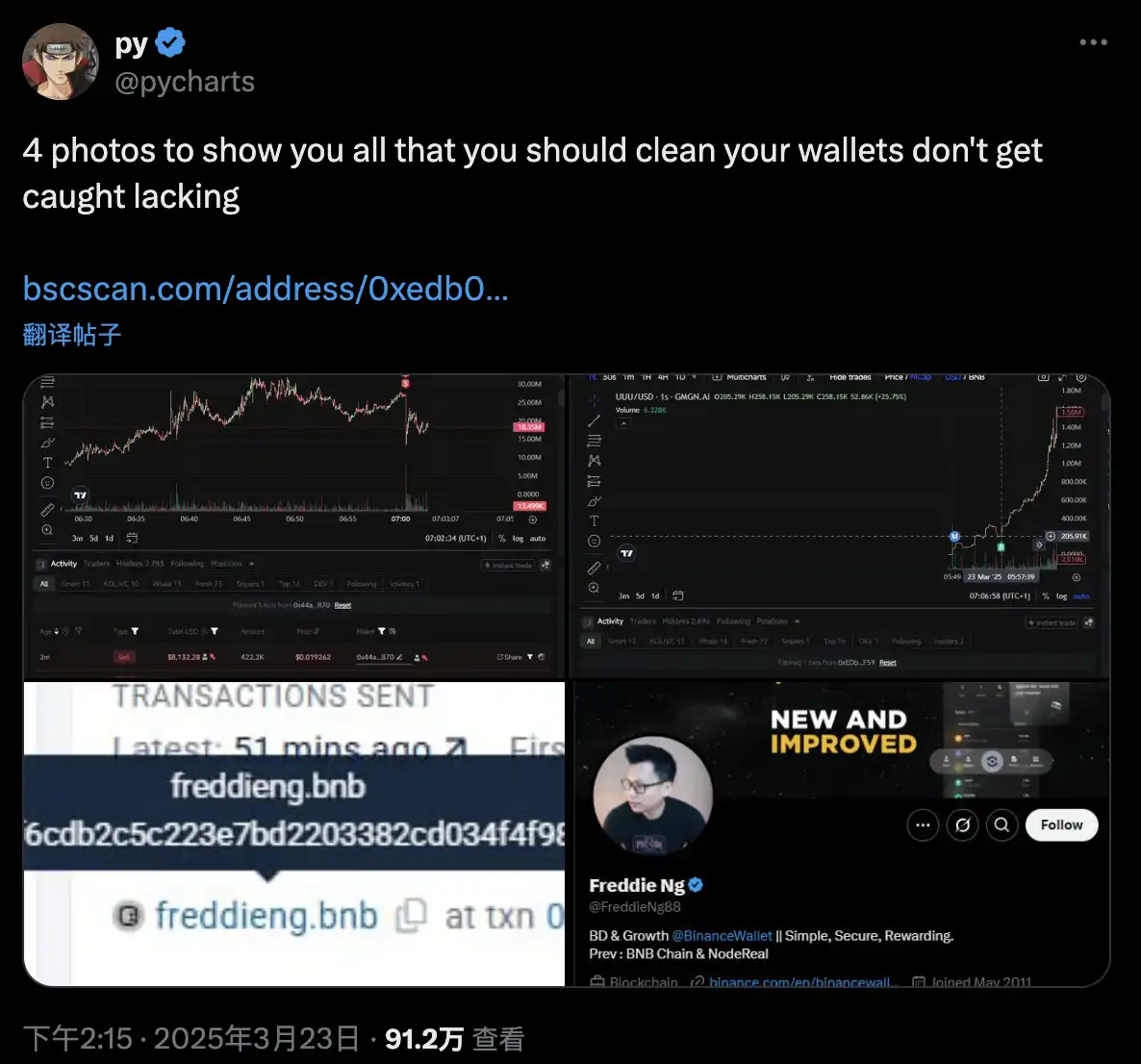
Responding to strong community demands, Binance announced the investigation results in less than 48 hours. According to Binance's announcement, after verification, the involved employee Freddie, who had moved from a BNB Chain business position to the Binance Wallet team a month prior, was suspected of using non-public information about the uDex project's TGE obtained from his previous role to purchase a large amount of $UUU with a related wallet before the project token listing announcement, sold a portion of the tokens after the announcement for profit, and the remaining holdings also showed significant unrealized gains. This behavior constituted insider trading taking advantage of inter-departmental information asymmetry, while also violating Binance's employee rules such as the "5000U Coin Trading Limit" and "90-Day Job Cooling-Off Period." The implicated employee has been suspended, and Binance is cooperating with the relevant legal jurisdiction to initiate legal proceedings, with the related assets being frozen.
Binance's First Public Handling of an Internal Employee
Due to the strong correlation between cryptocurrency value and its application with trading, coupled with on-chain privacy, it's almost inevitable to completely avoid "Insider Trading" behavior, and Binance is not the only trading platform where such behavior has occurred, nor is it the first time "Insider Trading" has emerged. The community has previously reacted to several actions suspected of insider trading, but it couldn't be proven to be related to Binance internally. As the world's largest cryptocurrency exchange, Binance's actions have a significant impact on the industry.
Previously, during a live stream, CZ mentioned that Binance's scrutiny of insider trading is quite strict, having rigorously reviewed over 100 employees in the past few years, of which half were fired, with most individuals' identities not made public. Users entrenched in the cryptocurrency industry are aware that with some basic on-chain knowledge, there are many methods to avoid on-chain identity exposure. If not for this "on-chain" + "off-chain" dual evidence this time, the community might never have known who? How many insiders? How it was handled? And in the imperfectly regulated Crypto space, it's highly likely that there won't be any legal consequences, at most, losing the ability to obtain "insider information" in the future.
Looking back at the rules traditional financial markets have in place to deal with insider traders, the concept originated from the highly integrated and developed investment banking and brokerage business in the United States in the 1970s, where conflicts of interest became increasingly severe. In 1970, the SEC began to require financial institutions to take measures to segregate sensitive information. At that time, the concept of the "Chinese Wall" was widely implemented. It refers to an isolation mechanism established within financial institutions to prevent the leakage of sensitive information between different departments due to conflicts of interest through various measures such as physical isolation, information isolation, transaction restrictions, compliance supervision, training, and penalties.
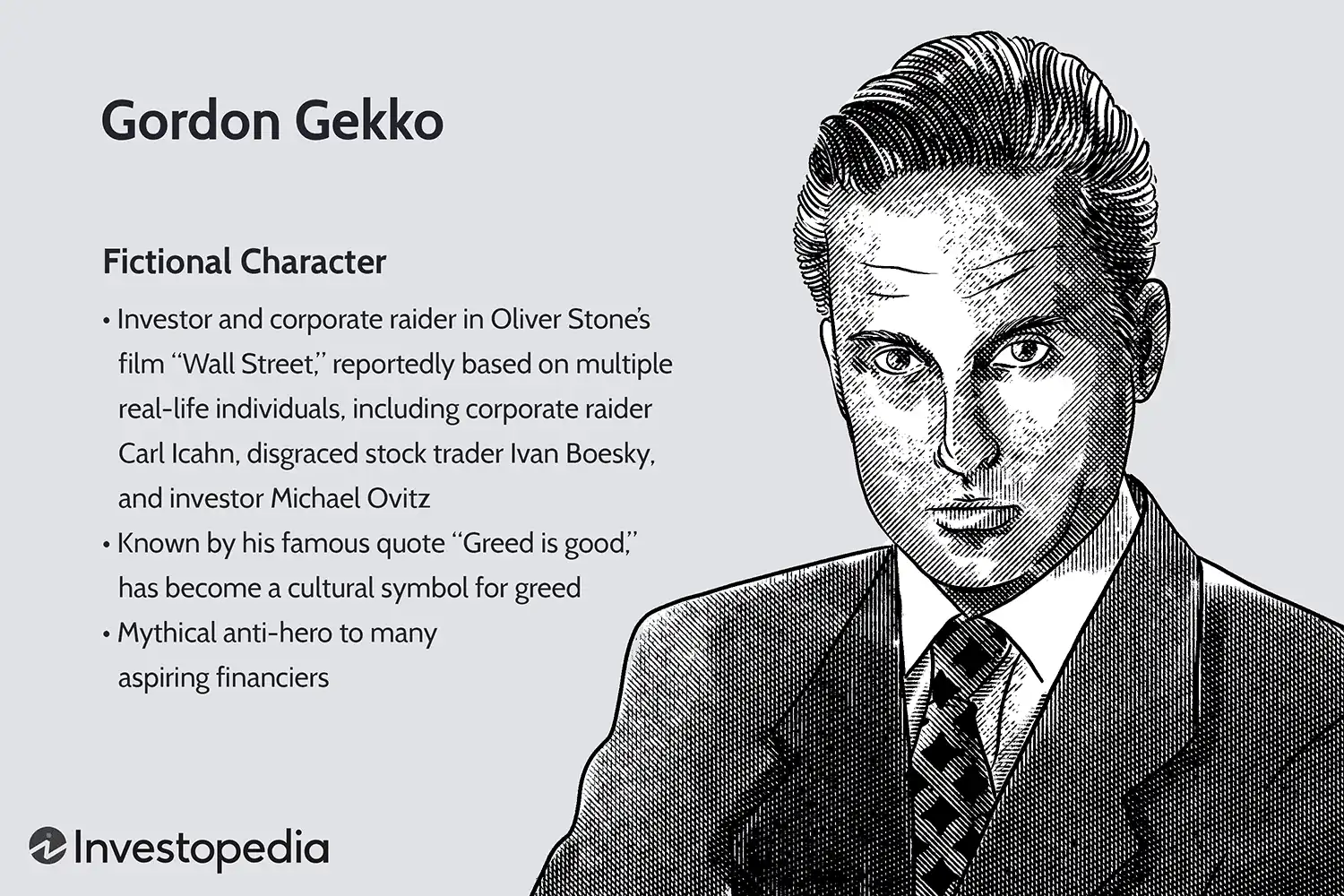
The prototype of the main character Gordon Gekko in the movie "Wall Street," Ivan Boesky, was fined $100 million for insider trading crimes in the 1980s and sentenced to three years in prison. This case directly prompted a revision of U.S. trading laws. The update of the Insider Trading and Securities Fraud Enforcement Act in 1988 clarified the punishment standards for insider trading and increased the maximum fine for violators. In 2007, Morgan's fund manager, Tang Jian, made a profit of 5 million RMB in the stock market's insider trading case, which also accelerated related industry regulations in China. The "Tang Jian case" led to the inclusion of the crime of "trading using undisclosed information" in the Criminal Law of the People's Republic of China Amendment (VII).
However, in any case, this is the first time Binance has publicly penalized an insider trading employee, and the follow-up handling of this incident will serve as a warning for employees who attempt insider trading in the future.
Can Self-Regulation Be Sustained?
Of course, Binance has already internally established fairly strict rules and regulations to create a "Chinese Wall" within the CEX. However, in a situation where the cost of "crime" is extremely low, such behavior is difficult to prevent. Whether the industry can find a way to balance the limits of "human" desires and community interests becomes crucial.
In addition to disclosing the investigation results in this incident, a reward of $100,000 was evenly distributed to 4 email addresses that reported through the official reporting channels. The announcement did not mention @pycharts, who first "whistleblew" on Twitter, which was also due to the single reporting channel and criteria. Unless there is a neglect of on-chain identity isolation, external parties will find it difficult to obtain direct evidence. The internal system of the trading platform can still be restricted by government regulations that issue local licenses, while affiliated wallets and chain ecosystem practitioners have fewer restrictions.
Similarly, Coinbase, as a top-tier trading platform, may face relatively less public opinion on "insider trading." Apart from being a publicly listed company subject to regulation, it is also related to its internal system. Coinbase strives to ensure the high cost of "insider trading" through a three-stage loop of "prevention-monitoring-punishment."
Coinbase prevents insider trading by implementing a cooling-off period policy (90-180 days trading freeze), a token trading blacklist (prohibition of listing and department-related token trading), and transaction limit restrictions (compliance platform monitoring, explanation required for anomalies).
Furthermore, they carry out on-chain address registration, utilize Chainalysis for monitoring, implement internal system permission layers, conduct behavior analysis and AI alerts (detecting anomalies through email, chat, and transaction data), all to prevent internal employees from accessing insider information sources.
Upon onboarding, mandatory training and agreement signing outlining the consequences of violations, establishment of an anonymous reporting channel (independent platform EthicsPoint providing protection and rewards), and transparent investigation and disclosure (cooperation with the SEC and publicizing results to optimize the process) are all in place to apply maximum criminal cost pressure on insider traders.
As early as July 2022, the SEC and the U.S. Department of Justice charged Coinbase's former product manager, Ishan Wahi, with insider trading involving 25 types of digital assets. Coinbase chose to proactively share the results of the internal investigation and received praise from the Department of Justice at that time. Unlike Coinbase, Binance is not currently a publicly traded company. Instead of sharing investigation results with regulatory agencies, Binance needs to maintain transparency with market participants. After having relatively comprehensive internal systems for prevention and monitoring, the key to industry self-regulation sustainability lies in how to enhance the "penalty" mechanism.
This incident once again sounded the alarm for the industry. While Binance, as a leading exchange platform, has implemented strict regulations to a certain extent, eradicating this human-driven "insider" conduct solely through individual project or entity rules may be challenging. It requires collaborative efforts across the entire industry to achieve.
You may also like

Russia’s Largest Bitcoin Miner BitRiver Faces Bankruptcy Crisis – What Went Wrong?
Key Takeaways BitRiver, the largest Bitcoin mining operator in Russia, faces a bankruptcy crisis due to unresolved debts…

Polymarket Predicts Over 70% Chance Bitcoin Will Drop Below $65K
Key Takeaways Polymarket bettors forecast a 71% chance for Bitcoin to fall below $65,000 by 2026. Strong bearish…

BitMine Reports 4.285M ETH Holdings, Expands Staked Position With Massive Reward Outlook
Key Takeaways BitMine Immersion Technologies holds 4,285,125 ETH, which is approximately 3.55% of Ethereum’s total supply. The company…

US Liquidity Crisis Sparked $250B Crash, Not a ‘Broken’ Crypto Market: Analyst
Key Takeaways: A massive $250 billion crash shook the cryptocurrency markets, attributed largely to liquidity issues in the…

Vitalik Advocates for Anonymous Voting in Ethereum’s Governance — A Solution to Attacks?
Key Takeaways Vitalik Buterin proposes a two-layer governance framework utilizing anonymous voting to address collusion and capture attacks,…

South Korea Utilizes AI to Pursue Unfair Crypto Trading: Offenders Face Severe Penalties
Key Takeaways South Korea is intensifying its use of AI to crack down on unfair cryptocurrency trading practices.…

Average Bitcoin ETF Investor Turns Underwater After Major Outflows
Key Takeaways: U.S. spot Bitcoin ETFs hold approximately $113 billion in assets, equivalent to around 1.28 million BTC.…

Japan’s Biggest Wealth Manager Adjusts Crypto Strategy After Q3 Setbacks
Key Takeaways Nomura Holdings, Japan’s leading wealth management firm, scales back its crypto involvement following significant third-quarter losses.…
CFTC Regulatory Shift Could Unlock New Opportunities for Coinbase Prediction Markets
Key Takeaways: The U.S. Commodity Futures Trading Commission (CFTC) is focusing on clearer regulations for crypto-linked prediction markets,…
Hong Kong Set to Approve First Stablecoin Licenses in March — Who’s In?
Key Takeaways Hong Kong’s financial regulator, the Hong Kong Monetary Authority (HKMA), is on the verge of approving…

BitRiver Founder and CEO Igor Runets Detained Over Tax Evasion Charges
Key Takeaways: Russian authorities have detained Igor Runets, CEO of BitRiver, on allegations of tax evasion. Runets is…

Crypto Investment Products Struggle with $1.7B Outflows Amid Market Turmoil
Key Takeaways: The recent $1.7 billion outflow in the crypto investment sector represents a second consecutive week of…

Why Is Crypto Down Today? – February 2, 2026
Key Takeaways: The crypto market has seen a downturn today, with a significant decrease of 2.9% in the…

Nevada Court Temporarily Bars Polymarket From Offering Contracts in the State
Key Takeaways A Nevada state court has temporarily restrained Polymarket from offering event contracts in the state, citing…

Bitcoin Falls Below $80K As Warsh Named Fed Chair, Triggers $2.5B Liquidation
Key Takeaways Bitcoin’s price tumbled below the crucial $80,000 mark following the announcement of Kevin Warsh as the…

Strategy’s Bitcoin Holdings Face $900M in Losses as BTC Slips Below $76K
Key Takeaways Strategy Inc., led by Michael Saylor, faces over $900 million in unrealized losses as Bitcoin price…
Trump-Linked Crypto Company Secures $500M UAE Investment, Sparking Conflict Concerns
Key Takeaways A Trump-affiliated crypto company, World Liberty Financial, has garnered $500 million from UAE investors, igniting conflict…

Billionaire Michael Saylor’s Strategy Buys $75M of More Bitcoin – Bullish Signal?
Key Takeaways Michael Saylor’s firm, Strategy, has significantly increased its Bitcoin holdings by acquiring an additional 855 BTC…
Russia’s Largest Bitcoin Miner BitRiver Faces Bankruptcy Crisis – What Went Wrong?
Key Takeaways BitRiver, the largest Bitcoin mining operator in Russia, faces a bankruptcy crisis due to unresolved debts…
Polymarket Predicts Over 70% Chance Bitcoin Will Drop Below $65K
Key Takeaways Polymarket bettors forecast a 71% chance for Bitcoin to fall below $65,000 by 2026. Strong bearish…
BitMine Reports 4.285M ETH Holdings, Expands Staked Position With Massive Reward Outlook
Key Takeaways BitMine Immersion Technologies holds 4,285,125 ETH, which is approximately 3.55% of Ethereum’s total supply. The company…
US Liquidity Crisis Sparked $250B Crash, Not a ‘Broken’ Crypto Market: Analyst
Key Takeaways: A massive $250 billion crash shook the cryptocurrency markets, attributed largely to liquidity issues in the…
Vitalik Advocates for Anonymous Voting in Ethereum’s Governance — A Solution to Attacks?
Key Takeaways Vitalik Buterin proposes a two-layer governance framework utilizing anonymous voting to address collusion and capture attacks,…
South Korea Utilizes AI to Pursue Unfair Crypto Trading: Offenders Face Severe Penalties
Key Takeaways South Korea is intensifying its use of AI to crack down on unfair cryptocurrency trading practices.…


 App
App