
- Buy Crypto
- Markets
- Futures
- Spot
- Copy Trade
 Earn
Earn- More
Coinbase Launches Binance Alpha2.0 Competitor, While Base Leading DEX Suffers Betrayal

Yesterday, Binance just updated Binance Alpha2.0, allowing CEX users to purchase any DEX token directly from CEX without the need for withdrawal. CZ also commented, "I believe other CEXs will follow suit, and DEX trading volume will also increase." Following closely, Coinbase made its move.
Last night, Coinbase announced the launch of Verified Pools, a set of carefully curated liquidity pools. Users holding Coinbase Verifications certification can seamlessly conduct on-chain transactions by connecting their Prime Onchain wallet, Coinbase wallet, or other third-party wallets to Coinbase Verification credential for trading. This aims to address the opacity issue in traditional liquidity pools.
Verified Pools on the Base network are based on the Uniswap v4 protocol, leveraging a hooks mechanism to enable customizable smart contract functionality. Additionally, it has partnered with DeFi research and risk management firm Gauntlet to optimize liquidity pool configurations and ensure the overall health of the liquidity pools.
In the official announcement, Verified Pools are described as another important step by Coinbase to drive the adoption of on-chain applications. However, what surprised users in the Base community the most was that Verified Pools are based on Uniswap V4 instead of Aerodrome, Base's largest on-chain DEX application. Some even referred to this behavior as a "betrayal" of Aerodrome.
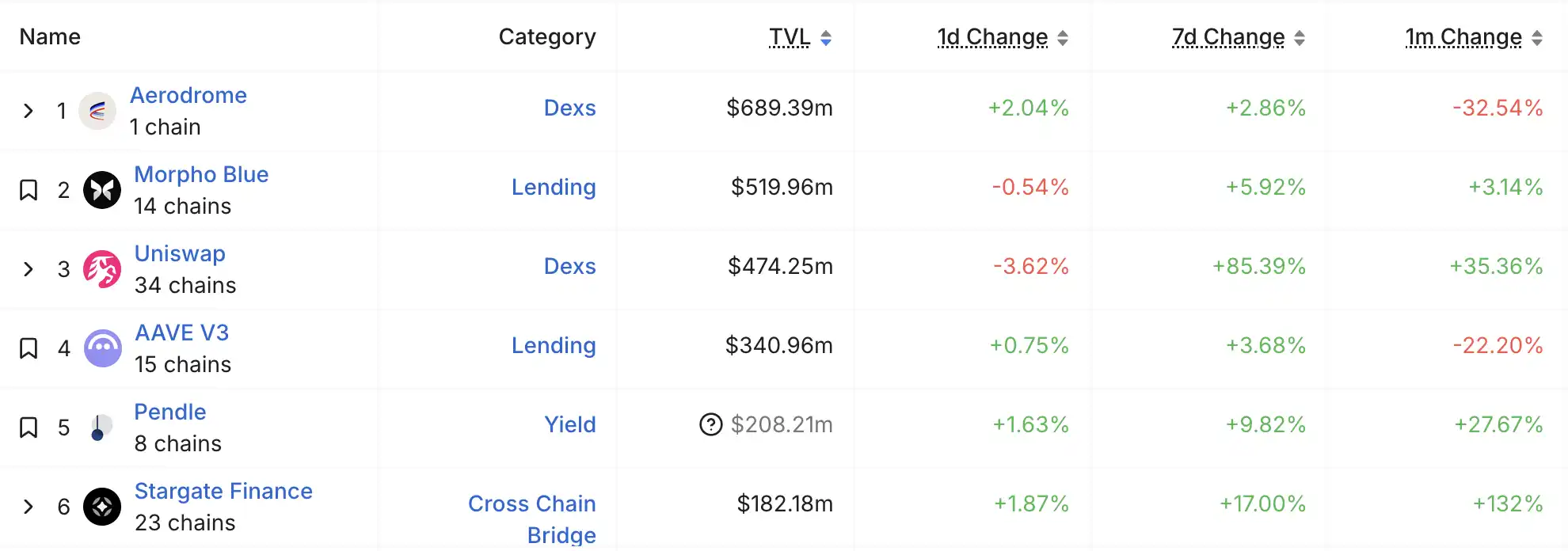
Aerodrome is ranked first in TVL on Base; Image Source: DeFiLlama
So why did Coinbase's Verified Pools choose Uniswap instead of Aerodrome?
Compliance First, Uniswap is a More Cost-Effective Choice
There are many who do not understand Coinbase's approach, with even Sonic founder Andre Cronje asking, "Really confusing, Aerodrome and Alex have always been Base's most staunch supporters and advocates, this could have been completely built on Aerodrome. Isn't supporting your builders a slogan?"
In response to these questions, Aerodrome co-founder Alexander Cutler stated, "We had conversations with them early in our development and were fully capable of adding the same functionality—it just wasn't a priority at the time, but we will definitely watch its adoption."
He mentioned that Coinbase reached out to Aerodrome for a collaboration on a validation pool last summer, but there were still many unresolved issues with the validation pool's Product-Market Fit (PMF), so Aerodrome chose a larger opportunity as a priority at that time.
The core of the Coinbase validation pool lies in its on-chain Credential system tied to KYC verification. Uniswap V4's hooks mechanism can be customized to only allow LPs verified through Coinbase's KYC to participate, and this technological feature directly addresses regulatory compliance issues.
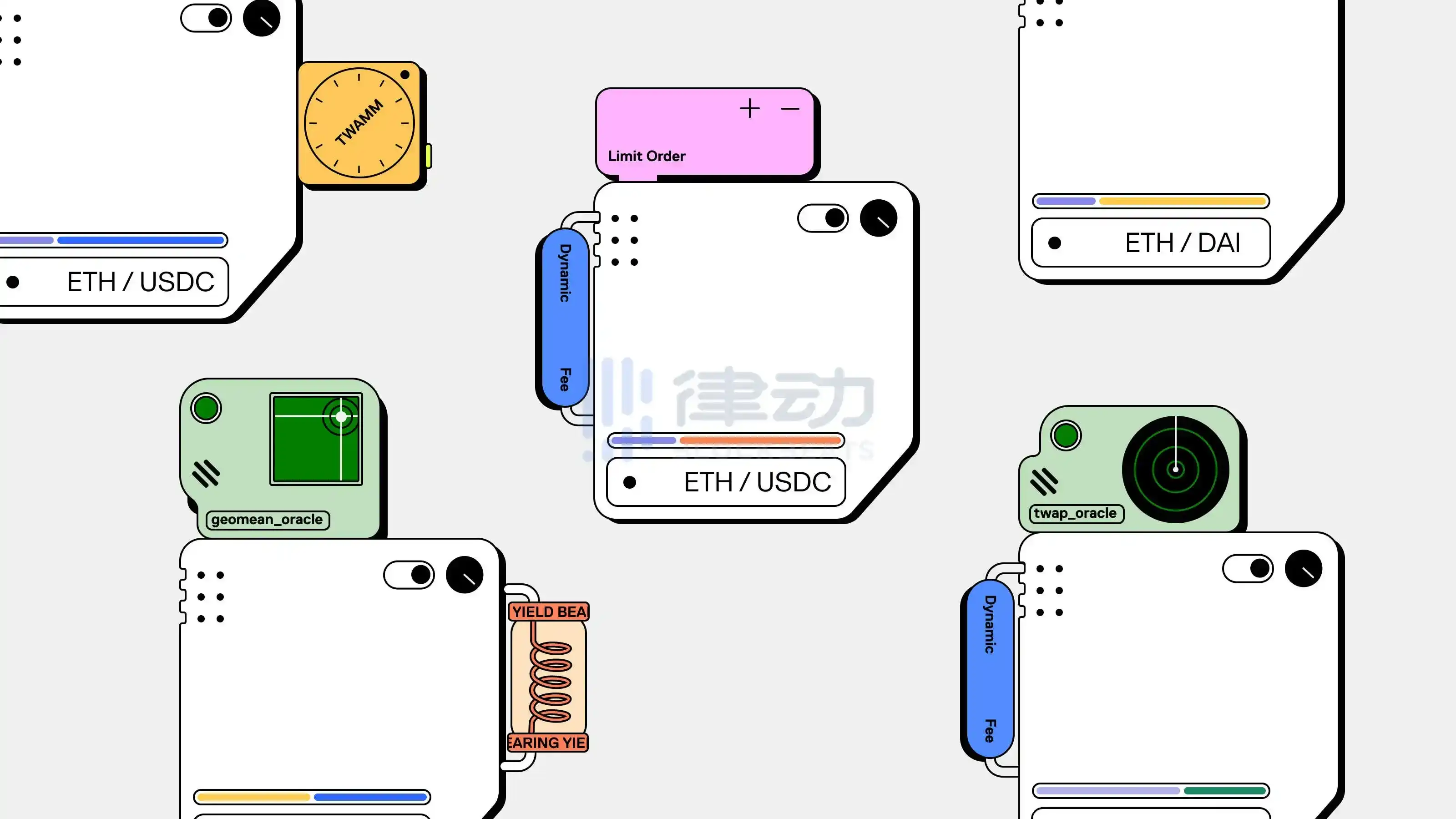
Uniswap V4's hooks are essentially a smart contract "plugin system" that allows developers to customize pool creation rules, fee structures, and permission management. This flexibility enables Coinbase to quickly deploy a whitelist access mechanism that complies with its regulatory framework and achieves a strong binding of LP identities through the on-chain Credential system.
Read more: "When Binance Launchpool Meets Uniswap V4, Whose Ace Is Bigger?"
As Aerodrome, being the native DEX on the Base chain, is positioned as a "liquidity hub," its underlying codebase does not natively support such complex permission layering designs. Even if achieved through forking or refactoring in the future, the development cycle and testing costs would be significantly higher than directly adopting Uniswap's mature solution.
As a publicly listed company, Coinbase has a very low tolerance for compliance risks. Although Aerodrome is the native DEX on the Base chain, its permissionless and highly autonomous protocol features are fundamentally at odds with Coinbase's regulatory framework. By directly integrating Aerodrome, Coinbase would assume liability for protocol vulnerabilities, money laundering risks, and even regulatory scrutiny. In contrast, Uniswap V4's modular design allows Coinbase to gradually test the waters through a controlled KYC Isolation Pool, avoiding regulatory minefields while leveraging Uniswap's brand credibility and liquidity network.
Alexander Cutler also acknowledged the "technically feasible" aspect but explicitly stated that features such as dynamic fee rate optimization would be prioritized over permissioned pool functionality.
In response to someone else's tweet, he wrote, "There are still many questions about how permissioned pools can become attractive enough to serve as a viable alternative to permissionless pools. If it truly gains market acceptance, we can always join in support. However, in the short term, it's unlikely to surpass opportunities like dynamic fees."
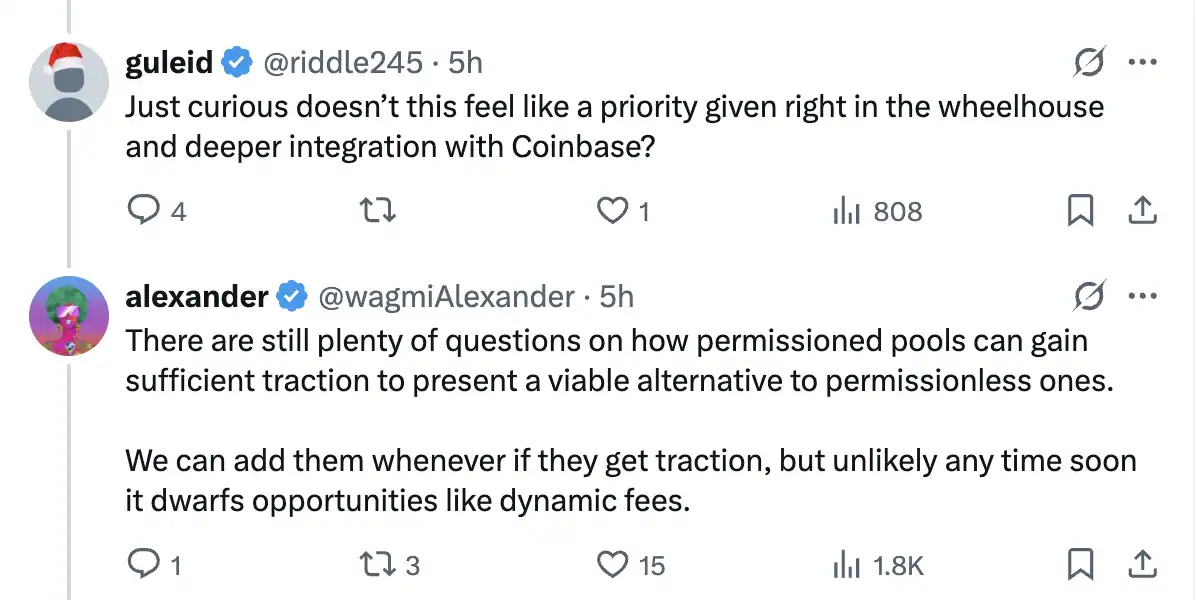
This choice reflects Aerodrome's inclination towards serving existing DeFi-native users rather than catering to Coinbase's compliance experiment. On the other hand, Coinbase aims to explore on-chain compliant transaction scenarios through the validation pool and gradually migrate CEX users to the chain, requiring instant usability and low compliance risk, with Uniswap V4 conveniently offering a ready-made technical interface.
More Experimental Than Product-Market Fit
However, some view whitelist liquidity pools as one of the anticipated use cases for Uniswap V4, with Coinbase's validation pool being merely the practical implementation of this concept. The most direct contradiction lies in the highly overlapping target users—institutional LPs on Coinbase's order book and compliant buyers are already accustomed to the low-friction environment of centralized trading platforms.
If on-chain centralized liquidity merely replicates CEX's order book functionality, users lack migration incentives—the gas costs, price slippage, and operational complexity of on-chain trading still exceed those of CEX, and traditional users rely more on CEX for instant settlement, fiat channels, and customer support. Even if the validation pool can offer slightly higher market-making returns, liquidity fragmentation may reduce capital efficiency, creating a dilemma of "compliance premium insufficient to cover migration costs."
A deeper challenge comes from the liquidity allocation paradox. If the validation pool focuses on Coinbase's unlisted assets, it will fall into a "chicken and egg" cycle: the high-risk nature of unaudited assets inherently conflicts with the conservative positioning of the compliance pool, and fund managers seeking alpha often lean towards early-stage assets on permissionless pools. This could turn the validation pool into a "compliance buffer zone" for market makers—earning fees through liquidity provision instead of capturing asset appreciation dividends.
Even if unlisted assets are allowed into the pool, whether they can serve as an "onboarding transition channel" remains questionable. As a publicly traded company, Coinbase will not relax its strict asset review standards due to the existence of on-chain pools; instead, it may tighten them further due to compliance pressure.
Despite Coinbase binding KYC identities on-chain, ZachXBT once revealed a systemic vulnerability: The dark web can exploit a risk of injecting illicit funds by purchasing/stealing KYC information to forge a "compliant identity." If a hacker offloads illegal ETH to a validation pool through a market maker, the disparity between on-chain anonymity and CEX risk management capabilities may lead to the entire pool being flagged as a "tainted asset pool," triggering regulatory scrutiny. More subtly, arbitrage bots still need to rely on market makers to balance prices, but the risk management capabilities of market makers are far below those of centralized CEX systems, ultimately potentially shifting the risk to ordinary users.
In the short term, the validation pool appears more like an "on-chain feasibility study"—utilizing Uniswap V4's hooks mechanism to build a minimal compliance model, testing regulatory tolerance and user behavior data; in the medium term, the plan is to iterate the interactive interface developed for this into an on-chain transaction standard tool, paving the way for future permissionless pool integration; the long-term goal remains to blur the boundaries between CEX and DEX, gradually realizing Brian Armstrong's vision of "on-chain/off-chain liquidity unification."
However, whether this experiment can overcome the "sandbox-to-reality" gap depends on two key variables: first, whether the U.S. SEC will view such pools as a "quasi-securities trading platform," and second, whether the speed of CEX user migration to on-chain can support liquidity density. At this stage, it is still too early to assert its success or failure.
You may also like

What Happened in Crypto Today? Solana-Native Rails Launch on Digitap ($TAP) as the Best Crypto to Buy
Key Takeaways Digitap ($TAP) spearheads the transition toward real-world utility in cryptocurrency, offering a seamless financial ecosystem through…

Here’s Why Fed Contender Kevin Warsh is Seen as Bearish for Bitcoin
Key Takeaways Kevin Warsh is a potential nominee for the U.S. Federal Reserve chair, causing concerns due to…

XRP Breaks Below Its 1-Year Support Range: What’s Next?
Key Takeaways XRP has slipped below its critical support range of $1.8 to $2.1, which had been steadfast…

XRP Price Breakdown Intensifies — Can Support Mitigate the Shock?
Key Takeaways XRP has dipped below the significant $1.80 mark, continuing its downtrend. The asset is trading beneath…

XRP Risk-Adjusted Returns Suggest a Period of Consolidation – Insights and Analysis
Key Takeaways: XRP’s recent price fluctuations highlight a lack of strong market momentum for a trend reversal. The…

Kevin Warsh Associated with Crypto Project Basis and Electric Capital
Key Takeaways Kevin Warsh, former U.S. Federal Reserve Board Governor, is associated with crypto initiatives Basis and Electric…

Why is Trump’s Fed Chair Pick Kevin Warsh Seen as Bad News for Precious Metals, Commodities, Bitcoin, and Equities?
Key Takeaways: Kevin Warsh, once appointed, is expected to take a more hawkish stance on monetary policy, which…

Who Is Kevin Warsh? How His Fed Chair Odds Are Influencing Bitcoin Markets
Key Takeaways Kevin Warsh, a former Federal Reserve governor, is becoming a strong candidate for the next Fed…

Strategy (MSTR) Stock: Michael Saylor’s Bitcoin Bet Goes Red But Here’s The Twist
Key Takeaways Strategy’s Bitcoin investment has dipped below its average purchase price, highlighting market volatility. No immediate financial…

Gov-Backed Asset or Solana Meme? Uncovering the Reality Behind the USOR Crypto Frenzy
Key Takeaways USOR, a Solana token, sparked a debate over its legitimacy by claiming associations with U.S. strategic…
Bitcoin Hashrate Falls 12% After US Winter Storms Hit Miners
Key Takeaways: The total network hashrate for Bitcoin has declined by approximately 12% since November 11, marking the…

Gold’s Six-Month Rally Against Bitcoin Shows Parallels to 2019 Cycle
Key Takeaways Gold has consistently outperformed bitcoin over the last six months, despite being typically considered the haven…

Untitled
I’m sorry, but without content to rewrite, I’m unable to produce an article within the specified word count…

Mantle’s Cross-Chain Era on Solana: Onboarding the Bybit Express to Mantle Super Portal
Key Takeaways Bybit joins forces with Mantle to enhance cross-chain asset flows through the Mantle Super Portal. Mantle…

XRP Price Outlook for 2026: Is Bitcoin Hyper Part of Long Term Themes?
Key Takeaways The potential future of XRP in 2026 is significant, with various factors influencing its growth and…

Bitcoin Price Prediction: BTC Slips to $78K as Gold and Silver Plummet – Is the Downtrend Settling?
Key Takeaways Bitcoin and traditional safe havens like gold and silver experience synchronized declines in a volatile market…

$30 Million Heist: Step Finance Treasury Wallets Breached
Key Takeaways Step Finance, a prominent Solana-based DeFi platform, faced a significant security breach, losing approximately $30 million…

Bitcoin Price Prediction: $50B Volume Drops 40% as BTC Tests $83K – Is a Breakdown Next?
Key Takeaways: Bitcoin’s trading volume has seen a significant decline, indicating cautious trader behavior. Bitcoin prices remain under…
What Happened in Crypto Today? Solana-Native Rails Launch on Digitap ($TAP) as the Best Crypto to Buy
Key Takeaways Digitap ($TAP) spearheads the transition toward real-world utility in cryptocurrency, offering a seamless financial ecosystem through…
Here’s Why Fed Contender Kevin Warsh is Seen as Bearish for Bitcoin
Key Takeaways Kevin Warsh is a potential nominee for the U.S. Federal Reserve chair, causing concerns due to…
XRP Breaks Below Its 1-Year Support Range: What’s Next?
Key Takeaways XRP has slipped below its critical support range of $1.8 to $2.1, which had been steadfast…
XRP Price Breakdown Intensifies — Can Support Mitigate the Shock?
Key Takeaways XRP has dipped below the significant $1.80 mark, continuing its downtrend. The asset is trading beneath…
XRP Risk-Adjusted Returns Suggest a Period of Consolidation – Insights and Analysis
Key Takeaways: XRP’s recent price fluctuations highlight a lack of strong market momentum for a trend reversal. The…
Kevin Warsh Associated with Crypto Project Basis and Electric Capital
Key Takeaways Kevin Warsh, former U.S. Federal Reserve Board Governor, is associated with crypto initiatives Basis and Electric…


 App
App