
- Buy Crypto
- Markets
- Futures
- Spot
- Copy Trade
 Earn
Earn- More
Founder of 1confirmation Voices Support for Ethereum and Vitalik: ETH Is Severely Undervalued

Original Title: Money, Blockchains and Social Scalability v2
Original Author: Nick Tomaino, Founder and General Partner at 1confirmation
Original Translation: Hailsman, ChainCatcher
Editor's Note: Recently, there has been a lot of FUD in the community regarding Ethereum, as well as debates around Layer 2 and the interests of the mainnet. In light of this, Nick Tomaino, Founder and General Partner of 1confirmation, expressed his support for Ethereum and Vitalik. He reexamined Ethereum from the perspective of social scalability as a trusted neutral, native internet store of value, pointing out that while Bitcoin has been embraced by mainstream financial markets and governments, ETH could potentially prove to be more socially scalable than BTC.
Social scalability refers to a system's ability to allow more people to participate and achieve mutual benefits. This is also a key reason why the cryptocurrency market has become a $2.9 trillion asset class today. In this article, I will explain what it is and why it is important.
In 2017, cryptographer Nick Szabo published an article titled "Money, Blockchains and Social Scalability," describing Bitcoin as a social breakthrough, which has now become a must-read article. Most people see cryptocurrency as purely a technological innovation and focus on technical scalability. However, I agree with Szabo's view that while technical scalability does play a role in social scalability, it is not the primary factor. The biggest winners will be those cryptocurrencies that achieve social scalability through the most trust neutrality and providing the greatest utility.
Bitcoin's Social Scalability
Bitcoin is the first trusted neutral, native internet store of value that is useful to people in the United States, China, Russia, Brazil, and hundreds of other countries around the world. When I say "trusted neutral," I mean fair, unbiased, and not influenced by minority groups. Trusted neutrality is a social construct, usually rooted in technology but ultimately based on various dynamic factors that influence human trust.
Trusted neutrality is something that protocols gain over time but is initiated by humans at the outset. Bitcoin was launched as open-source software, and anyone could read, run, write to, and own it in a fair competitive environment. Its launch was fair. There were no backroom deals, no reliance on celebrities, companies, or nations. The rules were clear from the beginning and remain unchanged. The community openly discussed everything on forums like Bitcoin Talk. To understand its ethos, one can read early articles by Hal Finney.
The trustless neutrality and practicality of Bitcoin have been key reasons for the development of the cryptocurrency industry. Initially, it was a grassroots movement initiated by the pseudonymous founder, Satoshi Nakamoto, and it was not owned by any individual or subject to any jurisdiction, providing a new global product that anyone in the world could use. Today, it has evolved into a $1.7 trillion asset, with some of the world's largest governments and companies actively embracing it as a store of value. The rules of the Bitcoin system remain hard to change, which is one of the key reasons for its continued adoption.
Bitcoin's growth has been remarkable, but the cultural decisions made by the early community to focus solely on money have limited the development of new Bitcoin developers and companies to use it for more than just currency. Despite extremists emphasizing Bitcoin's orthodoxy for the past 15 years, decentralized systems still have a huge opportunity to bring more freedom and progress beyond money to the world.
Is Social Scalability Really Important?
Social scalability is a key factor in Bitcoin's success, but by 2025, the importance of social scalability may be questioned. Today, among the top 9 cryptocurrencies by total market capitalization, 4 are essentially company coins (XRP, BNB, SOL, TRON). The total market capitalization of these 4 coins exceeds $312 billion.
These tokens have strong narratives but have yet to gain trustworthy neutrality. Small teams have launched these tokens from well-known jurisdictions (Silicon Valley, the U.S., and China) and allocated over 50% of the tokens to insiders (founder teams and/or venture capital firms). They engage in highly coordinated marketing activities, with insiders involved in government lobbying and participating in a significant amount of corporate-style top-down activities. These protocols have yet to demonstrate resilience, security, and anti-single-point-of-failure properties. They have made aggressive trade-offs for performance at the expense of sacrificing decentralization.
We can discuss their practicality—some may argue that these 4 protocols are useful, but they have not enabled new use cases or broader adoption. Nonetheless, the approach taken by these 4 protocols has been highly effective. It could also be argued that they have been successful in capturing value, with little to do with so-called social scalability.
However, in the long run, social scalability is crucial and expected to bring $20 trillion in value growth over the next decade. This is why we insist here. Time will tell the truth, and things will change. If you indeed agree that social scalability is critical and look at the facts, it's quite evident that only two cryptocurrencies possess both trustworthy neutrality and practicality for achieving long-term social scalability: BTC and ETH.
BTC may reign supreme, but ETH could also prove to be more socially scalable than BTC. Here's why:
ETH's Trustless Neutrality
Similar to Bitcoin, Ethereum's trustless neutrality has been present from the start. While Ethereum didn't have Bitcoin's "fair launch," only 9.9% of the supply was allocated to insiders, making it easy for anyone in the world to own ETH by simply sending BTC to the ICO address. There were no insider transactions with VCs, no involvement of celebrities, companies, or nations.
Ethereum initially started as a proof-of-work (PoW) chain and remained PoW for the first 7 years to ensure a more equitable distribution before transitioning to proof of stake (PoS). You didn't need to own or buy ETH to participate in consensus and receive rewards early on; you just needed to contribute hashing resources. The transition from PoW to PoS was unique and underrated, as native PoS chains often reward early token holders disproportionately. This helped Ethereum engage a diverse set of stakeholders early on and allowed a broader participation in consensus and ETH rewards today.
Ethereum's founder is Vitalik Buterin. Some critics may question Vitalik's leadership and argue that a known founder holding significant sway damages the trustless nature. However, Vitalik's leadership is transparent and authentic, laying Ethereum's cultural foundation by emphasizing trustless neutrality.
You won't see Vitalik shilling investment narratives or chasing money, fame, and power like many prominent figures in the crypto space. For over a decade, he has been one of the most capable to operate this way but chooses not to. Instead, he operates in his way, emphasizing values like resistance to censorship, inclusivity, and transparency, primarily focusing on setting the best long-term technical architecture and values for builders.
In fact, Bitcoin and Ethereum share the same governance process. Changing the protocol requires rough consensus among miners, users, and developers, making Ethereum's change process much slower than many VC types would expect. However, in the long run, this contributes to a more robust neutrality, a conscious trade-off made by Ethereum's leadership.
The Ethereum mainnet currently has 4 execution clients (Geth, Nethermind, Besu, and Erigon) and 5 consensus clients (Prysm, Lighthouse, Teku, Nimbus, and Lodestar) actively maintained. Client diversity and avoiding single points of failure
Has always been a focal point. Additionally, the mainnet and L2 EVM environment have become the most trusted development environment for developers and companies.
Today, Michael Saylor's entity-owned BTC supply is much larger than Vitalik's and the Ethereum Foundation's ETH supply. The Bitcoin leader has accelerated government alliances by supporting politicians and lobbying. This may have furthered Bitcoin than Ethereum and attracted a broader set of stakeholders, which could potentially benefit Bitcoin.
However, the risk of Michael Saylor and government lobbying compromising trust neutrality is real, whereas Vitalik and the EF resist the urge to react to market sentiments by chasing investment narratives. The Ethereum leadership is focused on builders, and Ethereum is now much larger than any individual or group. The most critical people for Ethereum's future may be these unsung builders.
Ethereum's Utility

Since Bitcoin introduced the world to a trust-neutral, internet-native store of value tool, Ethereum has consistently captured developer attention and has been the birthplace of every major new cryptographic use case beyond currency, significantly bringing newcomers into the crypto space. Ethereum is the home of specific use cases such as decentralized finance (DeFi), non-fungible tokens (NFTs), prediction markets, decentralized social networks, decentralized identity, real-world assets (RWA), stablecoins, and more. All these new use cases, by distributing EVM wallets and ETH, have leveraged Ethereum's trust neutrality and value storage features.
Some of these use cases started on the Ethereum mainnet and are now gradually transitioning to building on top of Ethereum's L2 chain. Developers tend to favor a trusted developer environment that gives them more control and better economic benefits than L1, which is exactly what the Ethereum L2 architecture provides. Developers building on L2 or L3 not only gain more involvement but also enjoy Ethereum's security, the EVM's network effect, and expand Ethereum's consensus as a trust-neutral, internet-native store of value tool. Some developers of certain use cases may prefer to stay on the mainnet, as the liquidity advantage of the mainnet is unavailable on L2. Both outcomes are advantageous for ETH.
There has been much debate about whether L2 adds value to ETH or damages the value of ETH by cannibalizing mainnet fees. Standard Chartered recently lowered their price target for ETH from $10,000 to $4,000 based on L2 Base cannibalizing mainnet fees via Coinbase. This view overlooks the bigger picture.
The main benefit of L2 is not to contribute fees to the mainnet, but to expand Ethereum's consensus as a trusted, neutral, internet-native store of value by distributing EVM wallets and ETH. The ETH supply can decrease based on the usage of the Ethereum ecosystem (including mainnet and L2), a feature that has made ETH more deflationary than BTC, which is a nice feature. However, fees are not the main advantage of applications and L2.
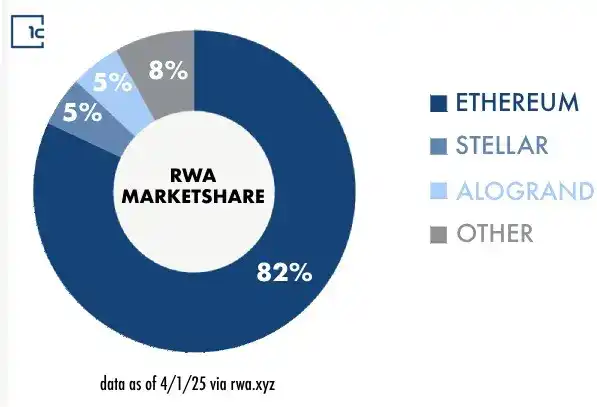
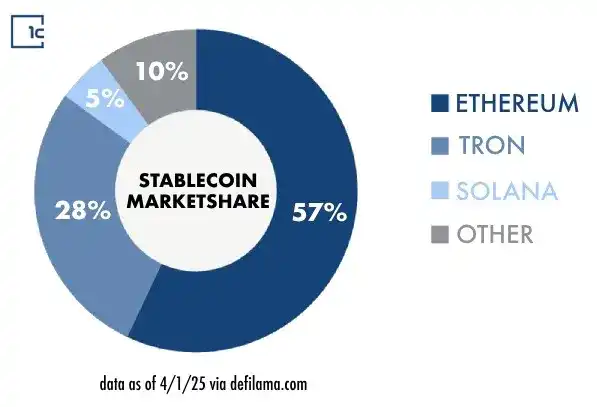
Ethereum Dominates Stablecoin, RWA, and NFT Use Cases
Ethereum is now the primary ecosystem where new developers and large companies (such as JPMorgan Chase, BlackRock, Coinbase, Robinhood, etc.) tokenize assets. Its ecosystem is increasingly expanding beyond NFTs and native cryptocurrency assets like tokens into areas such as the U.S. dollar, government bonds, stocks, bonds, private credit, real estate, and more. Whether these activities occur on the mainnet or L2, and how much L2 ultimately pays to the mainnet, will impact the scale of ETH burning. However, even in a scenario where all these activities take place on L2 and L2 pays minimal fees to the mainnet, the adoption of these use cases will still expand Ethereum's consensus as a trusted, neutral, internet-native store of value.
A $100 Trillion-Plus Opportunity
A trusted, neutral, internet-native store of value is the largest market opportunity in the world today. The total market value of gold is around $20 trillion, and the global M2 (broad money supply) is around $100 trillion, making it a market opportunity exceeding $100 trillion.
Cryptocurrencies that achieve social scalability through trust neutrality and utility are most capable of capturing this opportunity. The current narrative around this point is not strong, but from what I've learned in life and in crypto, the stronger the narrative, the further from the truth (and vice versa). Those who remain focused and are not swayed by hype chasing will reap the rewards.
You may also like
AI Trading's Ultimate Test: Empower Your AI Strategy with Tencent Cloud to Win $1.88M & a Bentley
AI traders! Win $1.88M & a Bentley by crushing WEEX's live-market challenge. Tencent Cloud powers your AI Trading bot - can it survive the Feb 9 finals?

Russia’s Largest Bitcoin Miner BitRiver Faces Bankruptcy Crisis – What Went Wrong?
Key Takeaways BitRiver, the largest Bitcoin mining operator in Russia, faces a bankruptcy crisis due to unresolved debts…

Polymarket Predicts Over 70% Chance Bitcoin Will Drop Below $65K
Key Takeaways Polymarket bettors forecast a 71% chance for Bitcoin to fall below $65,000 by 2026. Strong bearish…

BitMine Reports 4.285M ETH Holdings, Expands Staked Position With Massive Reward Outlook
Key Takeaways BitMine Immersion Technologies holds 4,285,125 ETH, which is approximately 3.55% of Ethereum’s total supply. The company…

US Liquidity Crisis Sparked $250B Crash, Not a ‘Broken’ Crypto Market: Analyst
Key Takeaways: A massive $250 billion crash shook the cryptocurrency markets, attributed largely to liquidity issues in the…

Vitalik Advocates for Anonymous Voting in Ethereum’s Governance — A Solution to Attacks?
Key Takeaways Vitalik Buterin proposes a two-layer governance framework utilizing anonymous voting to address collusion and capture attacks,…

South Korea Utilizes AI to Pursue Unfair Crypto Trading: Offenders Face Severe Penalties
Key Takeaways South Korea is intensifying its use of AI to crack down on unfair cryptocurrency trading practices.…

Average Bitcoin ETF Investor Turns Underwater After Major Outflows
Key Takeaways: U.S. spot Bitcoin ETFs hold approximately $113 billion in assets, equivalent to around 1.28 million BTC.…

Japan’s Biggest Wealth Manager Adjusts Crypto Strategy After Q3 Setbacks
Key Takeaways Nomura Holdings, Japan’s leading wealth management firm, scales back its crypto involvement following significant third-quarter losses.…
CFTC Regulatory Shift Could Unlock New Opportunities for Coinbase Prediction Markets
Key Takeaways: The U.S. Commodity Futures Trading Commission (CFTC) is focusing on clearer regulations for crypto-linked prediction markets,…
Hong Kong Set to Approve First Stablecoin Licenses in March — Who’s In?
Key Takeaways Hong Kong’s financial regulator, the Hong Kong Monetary Authority (HKMA), is on the verge of approving…

BitRiver Founder and CEO Igor Runets Detained Over Tax Evasion Charges
Key Takeaways: Russian authorities have detained Igor Runets, CEO of BitRiver, on allegations of tax evasion. Runets is…

Crypto Investment Products Struggle with $1.7B Outflows Amid Market Turmoil
Key Takeaways: The recent $1.7 billion outflow in the crypto investment sector represents a second consecutive week of…

Why Is Crypto Down Today? – February 2, 2026
Key Takeaways: The crypto market has seen a downturn today, with a significant decrease of 2.9% in the…

Nevada Court Temporarily Bars Polymarket From Offering Contracts in the State
Key Takeaways A Nevada state court has temporarily restrained Polymarket from offering event contracts in the state, citing…

Bitcoin Falls Below $80K As Warsh Named Fed Chair, Triggers $2.5B Liquidation
Key Takeaways Bitcoin’s price tumbled below the crucial $80,000 mark following the announcement of Kevin Warsh as the…

Strategy’s Bitcoin Holdings Face $900M in Losses as BTC Slips Below $76K
Key Takeaways Strategy Inc., led by Michael Saylor, faces over $900 million in unrealized losses as Bitcoin price…
Trump-Linked Crypto Company Secures $500M UAE Investment, Sparking Conflict Concerns
Key Takeaways A Trump-affiliated crypto company, World Liberty Financial, has garnered $500 million from UAE investors, igniting conflict…
AI Trading's Ultimate Test: Empower Your AI Strategy with Tencent Cloud to Win $1.88M & a Bentley
AI traders! Win $1.88M & a Bentley by crushing WEEX's live-market challenge. Tencent Cloud powers your AI Trading bot - can it survive the Feb 9 finals?
Russia’s Largest Bitcoin Miner BitRiver Faces Bankruptcy Crisis – What Went Wrong?
Key Takeaways BitRiver, the largest Bitcoin mining operator in Russia, faces a bankruptcy crisis due to unresolved debts…
Polymarket Predicts Over 70% Chance Bitcoin Will Drop Below $65K
Key Takeaways Polymarket bettors forecast a 71% chance for Bitcoin to fall below $65,000 by 2026. Strong bearish…
BitMine Reports 4.285M ETH Holdings, Expands Staked Position With Massive Reward Outlook
Key Takeaways BitMine Immersion Technologies holds 4,285,125 ETH, which is approximately 3.55% of Ethereum’s total supply. The company…
US Liquidity Crisis Sparked $250B Crash, Not a ‘Broken’ Crypto Market: Analyst
Key Takeaways: A massive $250 billion crash shook the cryptocurrency markets, attributed largely to liquidity issues in the…
Vitalik Advocates for Anonymous Voting in Ethereum’s Governance — A Solution to Attacks?
Key Takeaways Vitalik Buterin proposes a two-layer governance framework utilizing anonymous voting to address collusion and capture attacks,…


 App
App